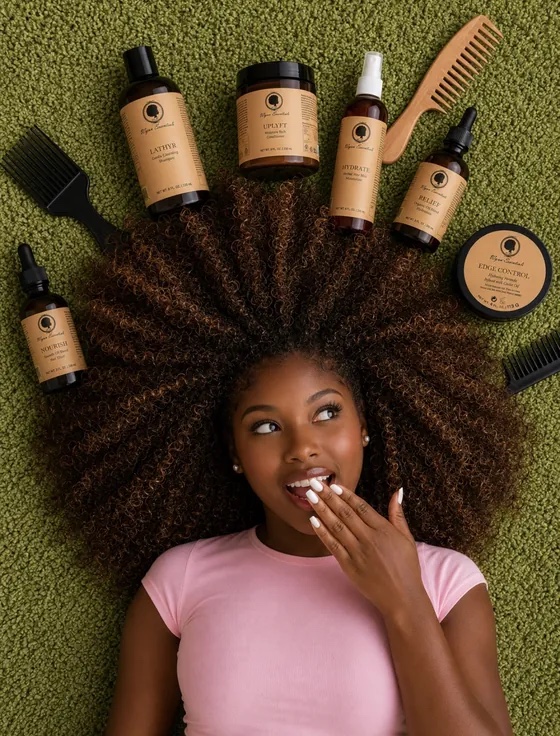
A reset is not punishment for what your hair has been through. It is a deliberate pause: notice what changed, remove what is no longer serving you, and rebuild from the scalp outward.
The deeper meaning
Textured hair responds to seasons, styling tension, product buildup, health, time and consistency. A useful reset separates a temporary symptom from a repeating pattern, then makes the routine simpler enough to repeat.
At Wynn Essentials, Healthy Hair Is a Practice means care is not a single product, a perfect style or a promise of overnight change. It is a repeatable relationship between knowledge, observation and action. The routine should make the hair easier to understand—not make the person feel as though her texture is a problem to solve.
What to pay attention to
Start with evidence you can see and feel: scalp comfort, buildup, tangling, breakage, elasticity, softness, shedding, the condition of the ends and how much tension a style creates. Products matter, but technique, frequency and the order of use often determine whether a product gets the chance to work as intended.
Textured hair is not one uniform category. Density, strand diameter, curl pattern, porosity, styling history and scalp condition can all change the best approach. Use general guidance as a starting point, then personalize it through careful observation.
Put it into practice
- Audit the scalp, strands, ends and current style separately.
- Clarify or cleanse according to buildup—not according to guilt.
- Restore slip and moisture before adding more styling products.
- Choose one small practice to repeat for the next four wash days.
The goal is not to complete every possible step. It is to understand why each chosen step is present and what result it should support. When something stops working, return to the evidence before buying more or adding complexity.
How to evaluate the result
Evaluate a routine by more than the first-day finish. Notice what happens during detangling, how the scalp feels between wash days, whether the ends remain pliable, how much hair is breaking during manipulation and how easily the next wash day begins. Those observations reveal whether the practice is supporting the hair—not merely coating it.
Keep the evaluation simple. Write down the date, the style, the products used and one or two observations. After several repetitions, look for a pattern. A single humid day, rushed wash or unfamiliar style can distort the result; a pattern gives you better information.
If the routine causes burning, persistent itching, sores, pain or sudden hair loss, stop treating the issue as a cosmetic adjustment. Those signs warrant professional evaluation. Healthy-hair education should help a person recognize the limit of home care, not encourage her to push through symptoms.
A Wynn Essentials reflection
Ask yourself: What is my hair requesting from me right now—and what part of that request can I meet consistently? That question keeps the practice responsive. It also leaves room for beauty, culture, creativity and ease to exist alongside hair health.
Frequently asked questions
What is the most important part of hair routine reset?
The most important part is consistency guided by observation. Start with the scalp and current condition of the hair, then choose the smallest useful action you can repeat.
How quickly should I change my routine?
Change one variable at a time when possible. Unless there is pain, irritation or significant breakage, give a well-chosen practice several uses so you can evaluate the pattern rather than one day.
When should I ask a professional for help?
Persistent itching, burning, sores, sudden shedding, bald patches or ongoing pain deserve attention from a board-certified dermatologist. A stylist can support technique, but a medical concern needs medical care.
Sources and further reading
- Hair-care tips from dermatologists — American Academy of Dermatology
- Hairstyles that pull can lead to hair loss — American Academy of Dermatology
This article is educational and is not medical advice. If you have persistent scalp symptoms or sudden hair loss, consult a board-certified dermatologist.